
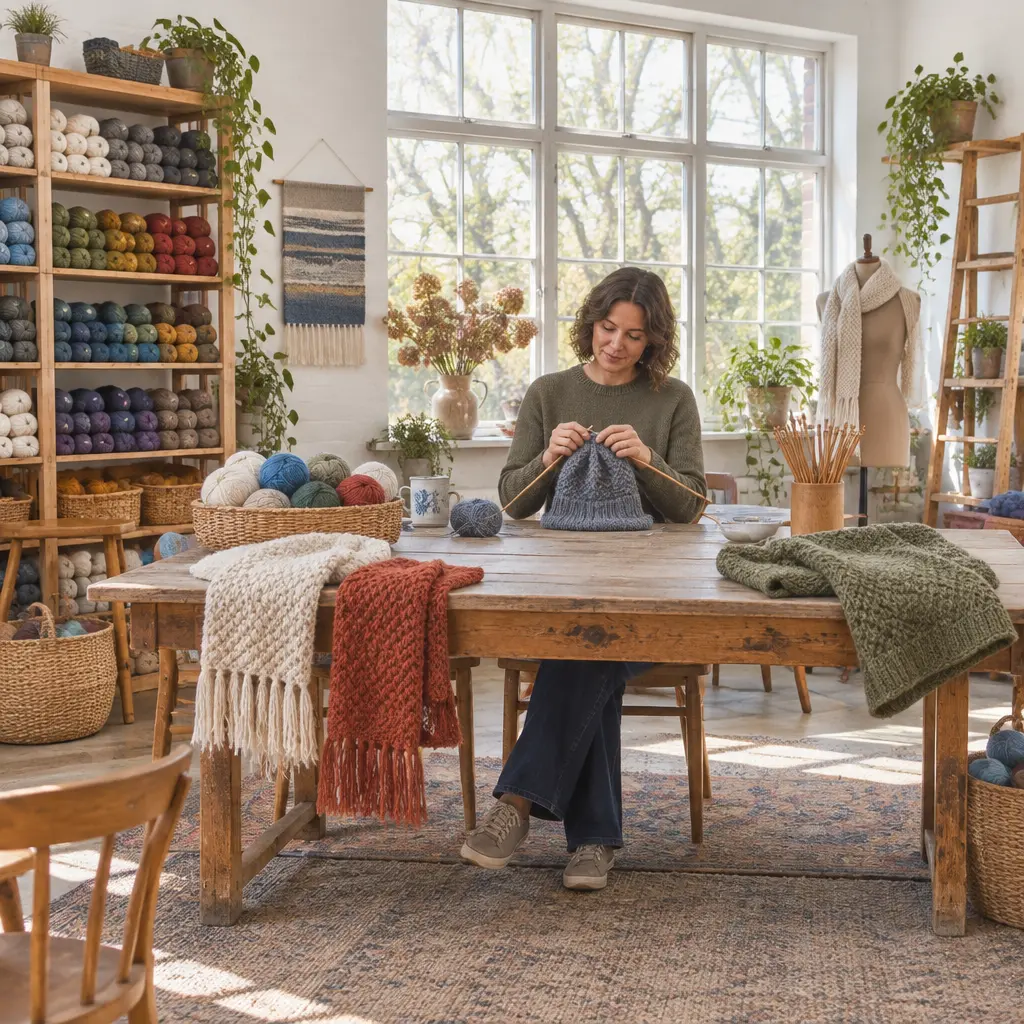
Knitted accessories are wearable items made by interlooping yarn with needles or a knitting machine; their quality depends on more than attractive patterns. It also reflects the maker’s material choices, technical skill, construction, and the time spent knitting, finishing, and checking each piece. The U.S. Bureau of Labor Statistics classifies knitting among craft and fine-art activities, while the Craft Yarn Council’s consumer research documents the broad participation of Americans in yarn crafts. Understanding how skill and time shape a finished accessory helps explain differences in fit, durability, comfort, and price—and offers practical ways to assess a handmade hat, scarf, or pair of mittens.
Craftsmanship and the quality of knitted accessories
Craftsmanship in knitting is the ability to turn yarn and a pattern into a useful, consistent, well-finished object. The Craft Yarn Council’s knitting guidance describes knitting as forming fabric by drawing loops through other loops, a simple action whose results depend on stitch control, gauge, shaping, and finishing. A well-made accessory generally has an even fabric appropriate to its intended use, secure joins, stable edges, and a comfortable fit. These features are relevant whether the item is produced by hand or machine, although the processes and labor involved differ.
Stitch consistency and gauge
Gauge is the number of stitches and rows in a measured area of knitted fabric. It is a practical measure of how yarn, needles, stitch pattern, and knitting tension work together. If a maker’s gauge differs from the pattern’s gauge, a hat may come out too large or small, or a scarf may have a different width and drape. The Craft Yarn Council recommends making and measuring a gauge swatch when fit or finished dimensions matter. Even stitches are not an end in themselves: lace, cables, and textured patterns intentionally vary the fabric, but the variations should follow the design.
Construction, shaping, and finishing
Construction covers how an accessory is formed and assembled. A hat may be knitted in the round or in flat pieces and seamed; mittens need coordinated shaping for the thumb and hand; scarves depend on edges that remain stable during wear. Finishing includes weaving in yarn ends, sewing seams, blocking fabric into shape where appropriate, and checking for loose stitches or uncomfortable joins. The Craft Yarn Council’s pattern and technique resources treat these steps as part of knitting, not as optional decoration. Careful finishing can help an accessory keep its shape and withstand repeated use, though actual longevity also depends on fiber, construction, wear, and laundering.
Skill and time behind knitted accessories
The work behind an accessory combines learned technique with task-specific labor. A useful way to understand the time involved is to separate planning and preparation, knitting, and finishing. This distinction matters because a small item is not necessarily quick to make: complicated shaping or colorwork can require close attention, while a larger, simple scarf may involve many repetitive rows. The U.S. Bureau of Labor Statistics does not publish a standard production-time estimate for individual hand-knitted accessories, so exact claims should be based on a particular pattern, yarn, gauge, and maker rather than presented as universal benchmarks.
Planning and material selection
Planning involves choosing a pattern, fiber, yarn weight, needle size, and finished dimensions for the intended wearer and use. Wool, cotton, alpaca, and synthetic fibers differ in warmth, elasticity, weight, care requirements, and price. A hat intended for cold weather, for example, may call for a warm, resilient yarn, while an accessory meant for frequent washing may need a fiber and construction suited to that care routine. Swatching, checking measurements, and preparing yarn can add time before the main knitting begins, but can prevent costly changes later.
Knitting technique and complexity
Knitting time depends on the number of stitches and rows as well as the techniques used. Stockinette stitch is often relatively straightforward, while cables, lace, stranded colorwork, short rows, and frequent shaping require additional attention. A maker’s experience also affects pace, but speed alone does not establish quality: consistent tension and accurate pattern execution may be more important than finishing quickly. The Craft Yarn Council’s educational materials distinguish basic techniques from more advanced methods, illustrating why two accessories of similar size can require very different levels of skill.
Finishing, inspection, and care
Finishing time includes sewing, weaving in ends, blocking when suitable for the fiber and design, and inspecting the accessory for flaws. Care instructions are also part of a responsible handoff: some fibers tolerate machine washing, while others require gentler handling. The Federal Trade Commission’s textile labeling rules require many covered textile products to carry information about fiber content and country of origin, and care-label rules apply to specified apparel and textile products. These rules do not mean every handmade item has identical labeling obligations, but they underline the value of clear, accurate information for buyers.
Types of knitted accessories and their practical demands
Different accessory types put different demands on the knitter. Their design determines how much shaping, sizing, and finishing is needed, while intended use influences the choice of yarn and fabric density. Comparing common items makes the relationship between craft decisions and everyday performance easier to see.
Hats and beanies
A knitted hat is a fitted head covering, commonly made with ribbing at the brim and decreases at the crown. Its comfort depends on circumference, stretch, yarn behavior, and the depth of the finished fabric. A gauge mismatch can noticeably change fit, so measuring the wearer or comparing the finished dimensions with a reliable pattern is useful. Cables or colorwork add visual interest but may also change fabric thickness and elasticity.
Scarves and cowls
A scarf is a long, usually rectangular strip of knitted fabric; a cowl is a shorter loop or tube worn around the neck. Scarves often require extended repetitive knitting, making length and edge stability important considerations. Cowls may involve joining the work in the round and choosing a circumference that fits comfortably over the head. For either type, yarn softness, drape, and care needs affect how pleasant the accessory is to wear.
Mittens, gloves, and socks
Mittens cover the fingers together, while gloves separate them; knitted socks are shaped garments designed to fit the foot and leg. These accessories require more detailed shaping than a simple rectangle. Thumb placement, finger length, heel construction, and foot measurements all influence fit. Areas exposed to friction, such as palms, fingertips, heels, and toes, may wear sooner, so fiber choice and reinforcement can matter as much as appearance.
Valuing handmade knitting and assessing quality
The value of a handmade accessory reflects materials, labor, design, and the maker’s expertise. The U.S. Bureau of Labor Statistics’ Occupational Outlook Handbook explains that craft and fine artists create objects using techniques that can include knitting, while its employment statistics do not provide a standardized price for individual knitted goods. As a result, fair pricing is usually assessed item by item rather than inferred from a single national average. Buyers can evaluate workmanship by checking fit, fabric consistency, joins, finishing, fiber information, and care guidance.
A practical quality checklist
- Check that the item’s dimensions and stretch suit its intended wearer and use.
- Look for secure seams, woven-in ends, and no obvious dropped or loose stitches.
- Consider whether the fabric density and fiber are appropriate for the climate and activity.
- Ask what the item is made from and how it should be washed and dried.
- For patterned work, check that shaping and repeated motifs appear intentional and consistent.
For example, a hand-knitted hat with a carefully measured brim, even colorwork, and securely finished crown may require more expertise than a plain hat of similar size. A simple scarf can still represent substantial labor because of its length. In both cases, the finished object should be judged in context: complexity, materials, fit, and durability matter more than stitch count or speed alone.
Conclusion: skill, time, and lasting usefulness
Well-made knitted accessories bring together controlled gauge, sound construction, appropriate materials, and careful finishing. The time behind them varies with the accessory’s size, pattern, and shaping, while the maker’s skill influences fit, consistency, and durability. Hats, scarves, cowls, mittens, gloves, and socks each present different design challenges, so quality is best assessed by how well an item serves its intended purpose. When buying or making knitted accessories, consider the fiber, measurements, construction, and care instructions—and support makers by recognizing the labor behind their work. For further learning, consult the Craft Yarn Council’s knitting education resources and compare pattern guidance with the needs of the intended wearer.
Sources: Craft Yarn Council, Learn to Knit, https://www.craftyarncouncil.com/learn-to-knit; Craft Yarn Council, Yarn Standards and Guidelines, https://www.craftyarncouncil.com/standards; U.S. Bureau of Labor Statistics, Occupational Outlook Handbook: Craft and Fine Artists, https://www.bls.gov/ooh/arts-and-design/craft-and-fine-artists.htm; Federal Trade Commission, Threading Your Way Through the Labeling Requirements Under the Textile and Wool Acts, https://www.ftc.gov/business-guidance/resources/threading-your-way-through-labeling-requirements-under-textile-wool-acts