
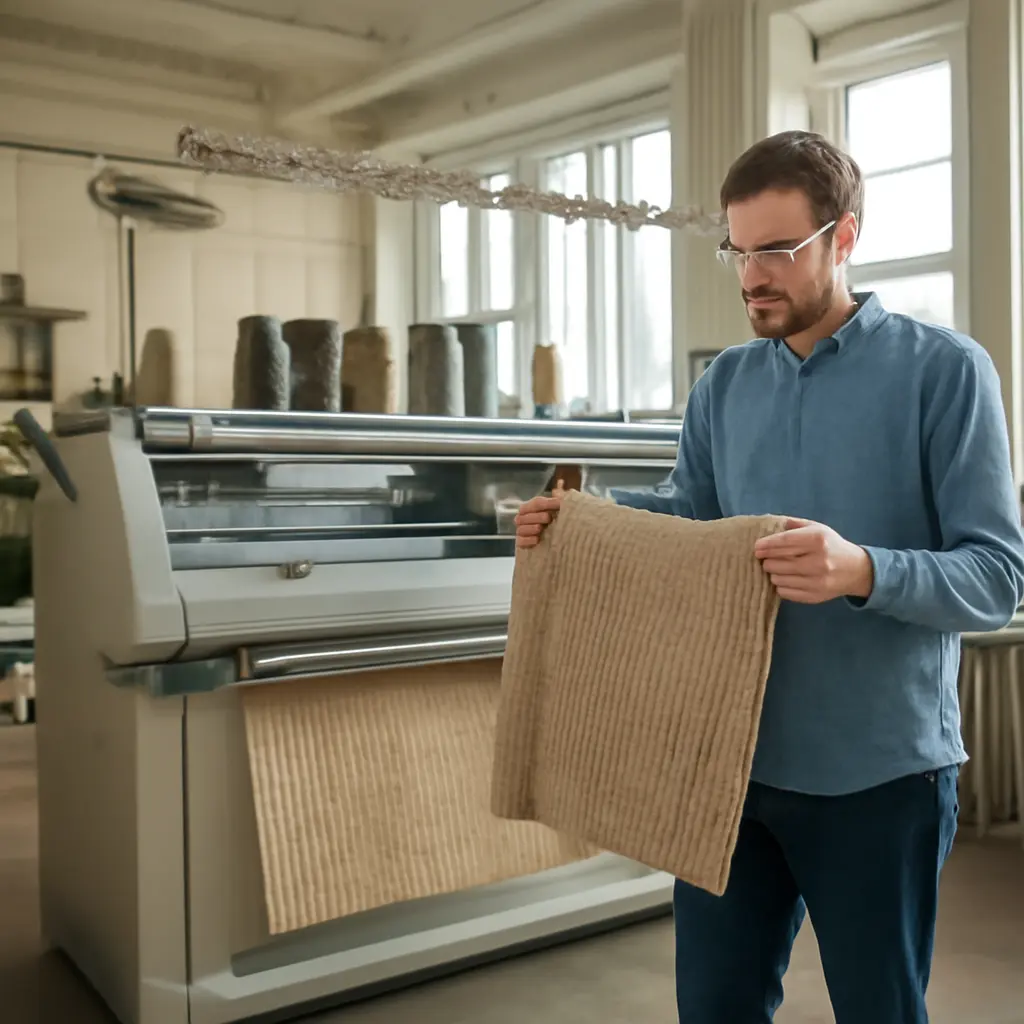
Knitting technology split into two influential paths: automated, high-volume production for commercial markets and specialized, design-led techniques for high fashion. The pivotal change was not one stitch but the development of flat-bed knitting machines capable of shaping garments, varying stitch structures, and reducing seams—capabilities that designers such as Issey Miyake and manufacturers such as Shima Seiki turned into new ways to make clothing. This article traces that technological shift, explains the stitch and machine innovations behind it, and considers how they reshaped fashion, production, and sustainability.
How knit technology separated commercial knitting from high fashion
Knitting is the interlooping of yarn to form a flexible fabric or garment. The “stitch revolution” is a useful shorthand for the combined advances in machine control, shaped knitting, and stitch programming that made it possible to produce both standardized goods at scale and complex, sculptural garments with fewer seams. It was a gradual transformation rather than a single invention: industrial circular machines accelerated commodity production, while increasingly programmable flat-bed machines gave designers finer control over garment shape and surface.
The distinction matters because knitting is a major global apparel process, but production statistics do not neatly separate high-fashion knitwear from mass-market clothing. The International Textile Manufacturers Federation’s industry surveys track global textile machinery and production, while company histories document the spread of computerized equipment. Together, these sources show how automation expanded output even as specialized machines enabled experimentation. The result was not simply “cheap knitting” versus “luxury knitting,” but two overlapping systems with different priorities: throughput and consistency on one side, material expression and design control on the other.
Machine knitting defined the stitch revolution
A knitting machine forms fabric by using needles to pull yarn through existing loops. The Textile Institute’s technical literature distinguishes weft knitting, in which loops are generally formed across the fabric’s width, from warp knitting, in which yarns run lengthwise in coordinated paths. The most consequential fashion shift came from computer-controlled flat-bed weft knitting: designers could program needle selection and stitch changes across a garment panel, and later systems could shape garment pieces directly rather than producing only rectangular fabric.
The main machine families illustrate the contrast. Circular knitting machines make continuous tubes of fabric rapidly and are widely suited to T-shirts, underwear, and jersey yardage. Warp-knitting machines are valued for stable, run-resistant structures used in areas such as sportswear and technical textiles. Flat-bed machines can create rib, cable, tuck, transfer, and intarsia effects, and can knit shaped panels or complete garments. These categories overlap in practice, but they reveal why a single industrial technology could serve both basic commerce and experimental fashion.
Circular knitting: speed and repeatability
Circular knitting uses needles arranged around a cylinder to make a continuous tube or, on some machines, open-width fabric. Its strength is efficient, repeatable production: once a fabric specification is set, the machine can produce long runs with consistent gauge and structure. This made circular knitting especially important to commercial basics, including T-shirts, leggings, socks, and underwear. It also supports fashion production, but its historic advantage has been economical yardage rather than intricate, individually shaped pieces.
The U.S. Environmental Protection Agency’s textile and apparel materials data underline the scale of the broader clothing system: in 2018, the United States generated 17 million tons of textile waste, with 11.3 million tons landfilled. Those figures include more than knitted clothing and are not a measure of circular-machine output, but they show why high-volume apparel methods are increasingly scrutinized for overproduction and end-of-life impacts.
Flat-bed knitting: stitch control and garment shaping
A flat-bed machine holds needles on one or two flat beds and can select needles individually or in programmed groups. This allows changes in stitch, texture, color, and width within a piece. Shaping techniques—such as fashioning, narrowing, widening, and transferring loops—can produce panels that better match a garment’s contours. Unlike a simple cut-and-sew approach, shaped knitting can reduce fabric waste and the number of seams, although the actual savings depend on yarn, design, machine setup, and finishing.
Computerization made these capabilities more accessible and repeatable. Shima Seiki, a Japanese knitting-machine manufacturer, introduced its computerized WHOLEGARMENT system in the 1990s, promoting garments knitted in three dimensions with minimal or no sewing seams. The company’s machine technology became a practical bridge between industrial production and high-end design: the same programmable platform could make efficient commercial products or unusual forms, depending on the designer’s instructions.
Stitch structures: from basic jersey to sculptural surfaces
A stitch structure is the arrangement of loops and yarns that determines a knitted fabric’s appearance, stretch, weight, and behavior. Plain jersey, rib, and purl are foundational structures; tuck and miss stitches alter loop formation, while cable and transfer techniques rearrange loops to create relief and texture. Intarsia places distinct color areas into a knitted surface, whereas jacquard patterns typically manage multiple colors across a row. These are not merely decorative choices: they affect elasticity, thickness, stability, and the amount of yarn required.
In commercial knitting, structures are often selected for cost, comfort, durability, and reliable performance across large runs. In designer knitwear, stitch engineering can become the central visual language. A designer may use openwork, exaggerated ribs, variable gauge, or dimensional structures to make fabric behave more like a tailored shell or a soft sculpture. The technological shift therefore expanded the designer’s control over the textile itself, rather than limiting design to the cut and finish of already-made cloth.
High-fashion designers turned machine capacity into a design language
The arrival of programmable knitting did not automatically create high fashion; designers had to reinterpret machine capabilities as aesthetic possibilities. Fashion historians and museum collections document how Japanese designers in particular challenged conventional distinctions between garment, textile, and body. Their work showed that machine knitting could produce volume, movement, and surface effects associated with couture experimentation, while retaining the repeatability and technical precision of industrial equipment.
Issey Miyake and A-POC: clothing as a programmed textile
Issey Miyake’s A-POC project, developed with Dai Fujiwara and introduced around 1998, explored “A Piece of Cloth”: a continuous textile tube engineered so that garments could be cut or separated from it. The concept shifted part of clothing construction upstream into the textile-making process. Rather than treating fabric as a neutral sheet to be cut and sewn, A-POC treated the knit structure and garment plan as a connected design system.
The project is a useful case study in the commercial-fashion divide because it joined industrial machinery to a radical design proposition. It was not simply a claim that knitting eliminated waste; cutting, finishing, and production choices still matter. Its significance was conceptual and technical: programmable knitting could embed garment possibilities into the cloth itself, allowing consumers and designers to participate in how the final form emerged.
Seamless garments and the WHOLEGARMENT approach
WHOLEGARMENT knitting produces a three-dimensional garment on a knitting machine, reducing or removing the need to join separately knitted panels. Fewer seams can improve comfort, simplify assembly, and reduce some manufacturing steps. The technique is especially suited to products where fit and a smooth interior matter, including knitwear, base layers, and selected performance garments.
However, seamless production is not automatically lower-impact or universally suitable. Machine time, yarn choice, energy use, garment complexity, and finishing all influence environmental performance. The Global Fashion Agenda and Boston Consulting Group’s 2017 Pulse of the Fashion Industry report estimated that the apparel and footwear industries generated about 5 percent of global greenhouse-gas emissions at the time; the estimate covers the wider sector, not knitting alone. Seamless and whole-garment methods are best understood as tools that can improve material and labor efficiency when matched to an appropriate product and production plan.
Commercial knitting and designer knitting diverged in priorities, not in technology
The difference between commercial and high-fashion knitting is chiefly one of production priorities. Commercial systems emphasize dependable output, low unit cost, stable quality, and the ability to meet large orders. High-fashion work may prioritize silhouette, tactile character, limited runs, unusual yarns, or a distinctive stitch effect. Both sectors can use computerized flat-bed machinery, and both can benefit from efficient production; the same machine may serve a basicwear supplier one season and a designer collection the next.
Scale, cost, and consistency
Commercial knitting relies on repeatable specifications: gauge, yarn count, stitch density, color, and finishing must remain consistent across lots. Circular machines are particularly effective for continuous fabric, while automated flat-bed systems can make shaped components at scale. The International Textile Manufacturers Federation’s International Textile Machinery Shipment Statistics provide a recurring measure of global machinery deliveries, including knitting equipment, but they do not isolate the number of machines used for luxury fashion. That limitation is important: machine shipments are evidence of industrial capacity, not a direct measure of fashion-market output.
For brands, the practical advantages include reduced manual handling, shorter assembly routes, and more predictable production. Yet automation does not remove the need for skilled technicians. Operators must select yarns, calibrate machines, interpret digital programs, troubleshoot defects, and manage finishing. The revolution changed the skill mix rather than making expertise obsolete.
Design freedom, limited editions, and craft knowledge
High-end knitting often uses the machine as a flexible design instrument. Designers can test unusual stitch combinations, vary density across a panel, or produce garments whose structure changes with movement. Small runs make experimentation easier, although specialized yarns, sampling, programming, and finishing can make each piece expensive. Hand knitting and hand finishing also remain important, demonstrating that machine innovation did not erase craft; it created new relationships between manual knowledge and digital control.
A contemporary collection may combine machine-knitted fabric with hand embroidery, linking, or finishing. This hybrid model is common because the machine excels at repeatable loop formation while human skill contributes judgment, adjustment, and surface detail. The historical separation between mass knitting and luxury knitwear is therefore better seen as a spectrum of production methods than as a strict boundary.
The stitch revolution changed production and raised new sustainability questions
Programmable knitting can support on-demand production, shaped components, and reduced cutting waste, but it cannot by itself solve fashion’s environmental problems. Waste depends on product planning, overproduction, fiber composition, durability, repair, and recycling infrastructure. The Ellen MacArthur Foundation’s 2017 report A New Textiles Economy estimated that less than 1 percent of material used to produce clothing was recycled into new clothing globally at that time. This figure describes the broader textile system and highlights why manufacturing efficiency must be paired with reuse and fiber-to-fiber recycling.
A useful visual for this history would be a timeline chart comparing milestones in flat-bed automation, computerized stitch selection, and whole-garment systems, alongside a process diagram contrasting cut-and-sew production with shaped or seamless knitting. Such a chart should distinguish documented machine launches from broader claims about market adoption, since adoption rates vary by region and product category.
- Design for the machine: selecting a structure and yarn that suit the intended garment can reduce sampling and production failures.
- Measure material use: compare fabric yield, offcuts, rejected pieces, and finishing inputs rather than assuming seamless means waste-free.
- Plan for longevity: durable construction, repairability, and clear fiber labeling influence a garment’s useful life and recyclability.
- Preserve skills: digital programming and machine maintenance require trained workers, alongside traditional knitting and finishing knowledge.
Conclusion: one stitch technology, two fashion economies
The stitch revolution separated commercial knitting from high-end fashion by expanding what machines could make, not by creating two unrelated technologies. Circular knitting strengthened high-volume, repeatable fabric production; computerized flat-bed knitting enabled more precise stitch control and garment shaping; and whole-garment systems brought three-dimensional construction closer to the machine. Designers such as Issey Miyake demonstrated that these capabilities could become an artistic language, while manufacturers applied them to efficiency and scale.
The broader implication is that fashion’s future depends on combining technical innovation with responsible production. Readers exploring knitwear can compare a circular-knit basic, a fashioned flat-bed garment, and a seamless whole-garment piece to see how construction shapes fit, waste, and labor. For deeper study, consult textile museums, machine-manufacturer archives, and current lifecycle research—and ask brands how their knitwear is made, where it is produced, and whether it can be repaired or recycled.
Sources: The Textile Institute, Textile Terms and Definitions, https://www.textileinstitute.org/; Shima Seiki, WHOLEGARMENT Technology, https://www.shimaseiki.com/wholegarment/; Issey Miyake, A-POC and design archive materials, https://www.isseymiyake.com/; International Textile Manufacturers Federation, International Textile Machinery Shipment Statistics, https://www.itmf.org/; U.S. Environmental Protection Agency, Textiles: Material-Specific Data, https://www.epa.gov/facts-and-figures-about-materials-waste-and-recycling/textiles-material-specific-data; Global Fashion Agenda and Boston Consulting Group, Pulse of the Fashion Industry 2017, https://globalfashionagenda.org/resource/pulse-of-the-fashion-industry-2017/; Ellen MacArthur Foundation, A New Textiles Economy: Redesigning Fashion’s Future, 2017, https://ellenmacarthurfoundation.org/a-new-textiles-economy