
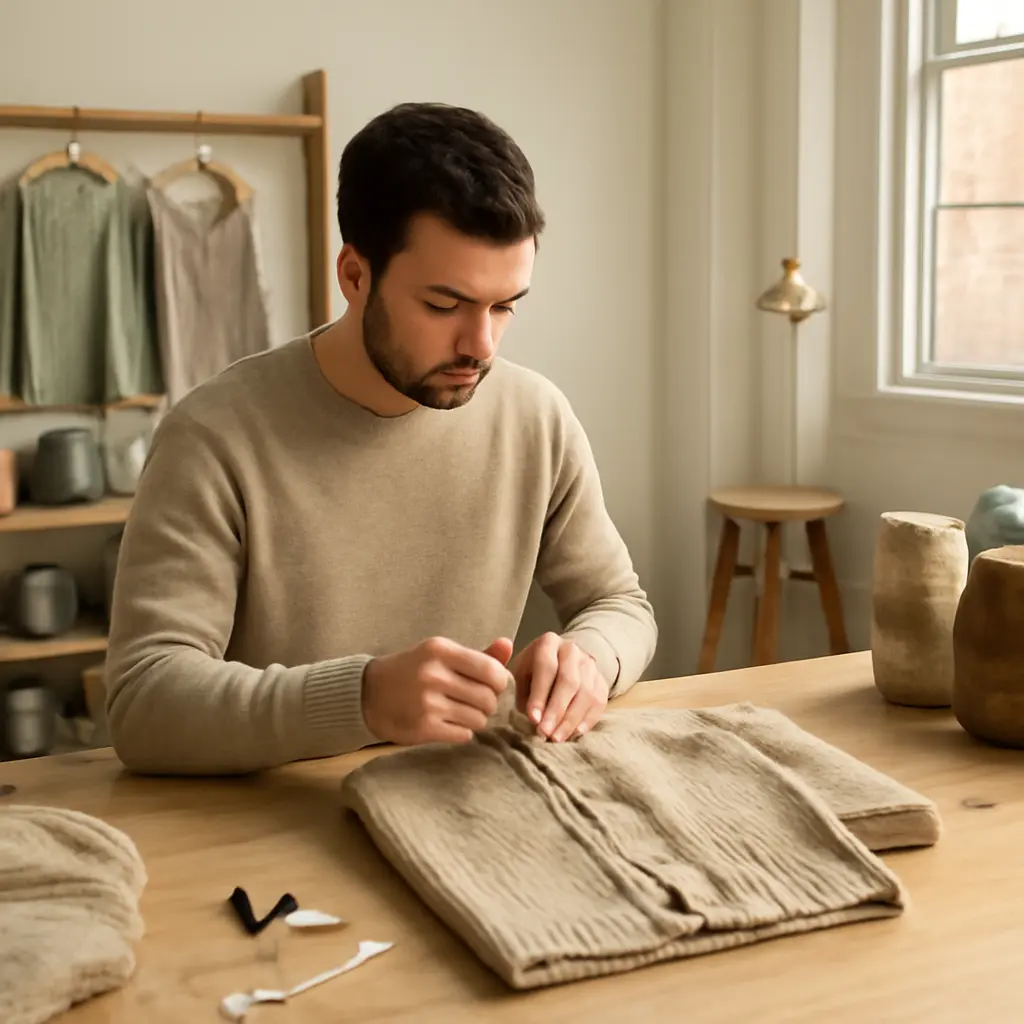
Hand-finished knitwear is knit clothing whose final details—such as seams, edges, buttons, or loose ends—are completed or refined by hand. It often costs more than mass-produced knitwear because it can involve more skilled labor, slower production, careful inspection, and higher-quality materials. That price can buy better finishing and a more traceable production process, but “hand-finished” alone does not guarantee superior yarn, durability, or ethical conditions. Understanding what the term means, how labor and materials affect price, and what to inspect before buying makes it easier to judge whether a particular piece is worth the premium.
Hand-finished knitwear prices reflect labor, materials, and construction
“Hand-finished knitwear” is not a single, standardized manufacturing category. It generally describes garments that may be machine-knit or hand-knit, then receive one or more finishing operations by hand. The final work can include linking knitted panels together, sewing on buttons, securing yarn ends, shaping or reinforcing edges, and checking the garment for defects. The exact meaning varies by maker, so buyers should ask which steps are actually done by hand.
The price difference is largely explained by time and the number of production steps—not by the label alone. The U.S. Bureau of Labor Statistics lists a 2023 median hourly wage of $16.44 for textile, apparel, and furnishings workers in the United States, illustrating that garment production involves paid labor even before retail, shipping, and business costs are added. That figure is not a knitwear-specific wage or a measure of what an individual maker earns, but it helps show why labor-intensive finishing cannot be cost-free.
A useful way to assess the premium is to separate the garment into three parts: what it is made from, how it is assembled, and how much time and skill the finishing requires. Those factors are related, but none can substitute for the others: a beautifully finished garment may still use low-grade yarn, while a fine fiber can be poorly assembled.
Hand-finished knitwear construction determines what the premium buys
In knitwear, finishing is the set of operations that turns knitted fabric or panels into a wearable, presentable garment. The International Textile and Apparel Association’s apparel-production literature distinguishes garment assembly and finishing operations from fabric formation; in practical knitwear production, the distinction matters because a machine can produce the knitted panels while a person performs detail work afterward.
Hand finishing can improve appearance and consistency when done carefully, but the value depends on the task. Linking seams, for example, can create a flatter join than a bulky seam, while a securely attached button can reduce the risk of losing it. These outcomes depend on workmanship and design, not simply on whether a worker used a hand tool.
Hand linking and seam finishing
Linking joins knitted stitches together, often by matching loops along garment edges. It is common in sweaters and can produce a neat, flexible seam when the stitch rows are aligned correctly. Hand linking may demand close attention to stitch count and tension; poor linking can cause puckering, gaps, or uneven shoulders. Ask whether the seams are linked, sewn, or assembled using another method, and inspect the inside of the garment for evenness and comfort.
Hand sewing, edges, and details
Hand-sewn details include attaching buttons, securing pockets, reinforcing stress points, and tidying cuffs or necklines. These operations can be important because closures and joins receive repeated strain. Look for buttons that sit securely without pulling the fabric, consistent edge shaping, and ends that are tucked away rather than left loose. A hand-sewn detail is valuable when it is durable and repairable—not merely because it was sewn by hand.
Blocking, pressing, and final inspection
Blocking shapes a knitted piece by applying controlled moisture and drying it to the intended dimensions; pressing or steaming may also be used, depending on the fiber and construction. A final inspection can identify dropped stitches, uneven seams, snags, or measurement variations. These are distinct steps: blocking can improve shape, while inspection catches faults. Buyers can check whether sleeves and hems hang evenly and whether the finished measurements match the maker’s size chart.
Hand-finished knitwear costs depend on fiber and production scale
Finishing labor is only one part of the price. Fiber type, yarn quality, garment complexity, production volume, and the route from maker to customer all affect cost. Smaller batches usually have fewer garments over which to spread design, setup, and quality-control expenses. A brand’s retail price may also include packaging, returns, taxes, wholesale margins, and business overhead, so it cannot be read as a direct measure of the maker’s pay.
Fiber quality and yarn choice
Wool, cashmere, cotton, alpaca, and synthetic fibers differ in feel, performance, care needs, and price. Even within one fiber category, quality varies with factors such as fiber length, fineness, processing, and yarn construction. The International Wool Textile Organisation describes wool as a natural, renewable, and biodegradable fiber, but those characteristics do not automatically make every wool garment long-lasting or environmentally preferable. Ask for the fiber composition and care instructions, and judge the yarn’s density and resilience alongside its softness.
Complexity and small-batch production
A plain pullover and a cardigan with pockets, patterned panels, multiple colors, and carefully matched seams do not require the same amount of work. More pieces and construction details create more opportunities for labor and quality checks. Small makers may also produce limited runs rather than thousands of identical units. This can support closer oversight and distinctive designs, but limited production by itself is not proof of better quality; construction details and transparent production information remain the stronger evidence.
Labor and a transparent price explanation
A credible maker should be able to explain where the garment is made, which steps are performed by hand, what the fiber content is, and how to care for the piece. The International Labour Organization has documented persistent labor and decent-work challenges across global garment supply chains, including low pay and pressure on working conditions. That context makes transparency relevant, but a higher price alone does not establish that workers receive fair wages. Look for specific information about the workshop, production location, and labor practices rather than relying on broad claims such as “ethical” or “artisan-made.”
Hand-finished knitwear may offer durability and repairability
Careful finishing can help a garment hold together, but lifespan also depends on fiber, knit structure, fit, use, and care. A sweater that is worn gently and stored properly may last longer than one exposed to abrasion, frequent washing, or unsuitable heat. The European Environment Agency has emphasized the environmental burden associated with textile production and consumption, making longer use and repair useful considerations when comparing purchases. A costly garment is not automatically sustainable; the strongest case is a well-made piece that the owner will wear and maintain for years.
Construction details that support longer wear
Inspect underarms, shoulders, cuffs, and button bands because these areas often experience stress. Stitches should be secure and reasonably consistent, seams should lie flat, and edges should not curl excessively unless that is an intentional design feature. Ask whether the maker offers repairs or replacement buttons. Repair support can extend a garment’s useful life, though it is worth checking whether the service is included, paid, or limited to certain defects.
Care and fiber-specific performance
Care requirements affect the real cost of ownership. Wool garments may need less frequent washing than many everyday tops, but they can felt or shrink if exposed to unsuitable heat, agitation, or detergent. Cotton and some synthetic blends may be easier to wash but can have different tendencies to stretch, pill, or lose shape. Follow the garment’s label rather than assuming all natural fibers need identical care. A lower-priced machine-made sweater that suits your routine may be a better purchase than a delicate piece you are unlikely to maintain.
Hand-finished knitwear labels need careful interpretation
Terms such as “hand-finished,” “handmade,” and “artisan” are often used in marketing, but they do not tell the whole production story. “Hand-finished” may mean only that a few final operations were done by hand; it does not necessarily mean the yarn was spun by hand or that the entire garment was knitted manually. Since definitions can vary between companies, a precise description of the work is more useful than a vague label.
Questions to ask before paying more
- Which specific steps are done by hand, and which are machine-made?
- Where are the yarn and garment produced?
- What is the complete fiber composition?
- How are seams, buttons, and stress points finished?
- What care does the maker recommend, and are repairs available?
- Can the maker explain the price in terms of materials, labor, and production scale?
A practical value check
Compare garments with similar fiber content, weight, design, and construction rather than comparing prices alone. Examine the inside as well as the outside, review the size and care information, and consider how often you expect to wear the item. Cost per wear can be a helpful personal calculation: divide the purchase price by the number of times you realistically expect to wear the garment. It is not a formal measure of quality or environmental impact, but it can clarify whether the higher upfront price fits your needs.
Conclusion: Hand-finished knitwear is worth judging by the work
Hand-finished knitwear can cost more because its final construction may require skilled, time-consuming work, alongside higher material and small-batch costs. The premium may buy flatter seams, carefully secured details, attentive inspection, and access to repair—but none of those benefits is guaranteed by the label alone. Fiber quality, construction, labor transparency, care demands, and the maker’s specific finishing methods all matter.
Before buying, ask what was actually finished by hand, inspect the workmanship, and choose a fiber and care routine that suit your life. For further reading, consult textile-care guidance from fiber organizations and labor information from the International Labour Organization. A thoughtful purchase is not simply the most expensive sweater; it is the one whose quality, origin, and expected useful life justify its price to you.
Sources: U.S. Bureau of Labor Statistics, Occupational Employment and Wage Statistics, Textile, Apparel, and Furnishings Workers, https://www.bls.gov/oes/2023/may/oes516000.htm; International Wool Textile Organisation, Wool: The Natural Fibre, https://iwto.org/wool/; International Labour Organization, The Future of Work in Textiles, Clothing, Leather and Footwear, https://www.ilo.org/sector/Resources/publications/WCMS_669355/lang–en/index.htm; European Environment Agency, Textiles and the Environment: The Role of Design in Europe’s Circular Economy, https://www.eea.europa.eu/publications/textiles-and-the-environment-the; International Textile and Apparel Association, Apparel Production and Textile Construction educational resources, https://itaaonline.org/.